Research Projects

Infant Developmental Assessment Using Video and Eye Gaze Measurement

Applied Systems and Interface Development
Infant Developmental Assessment Using Video and Eye Gaze Measurement

Research Overview

Supporting developmental and ASD risk assessment by quantifying spontaneous movements and gaze

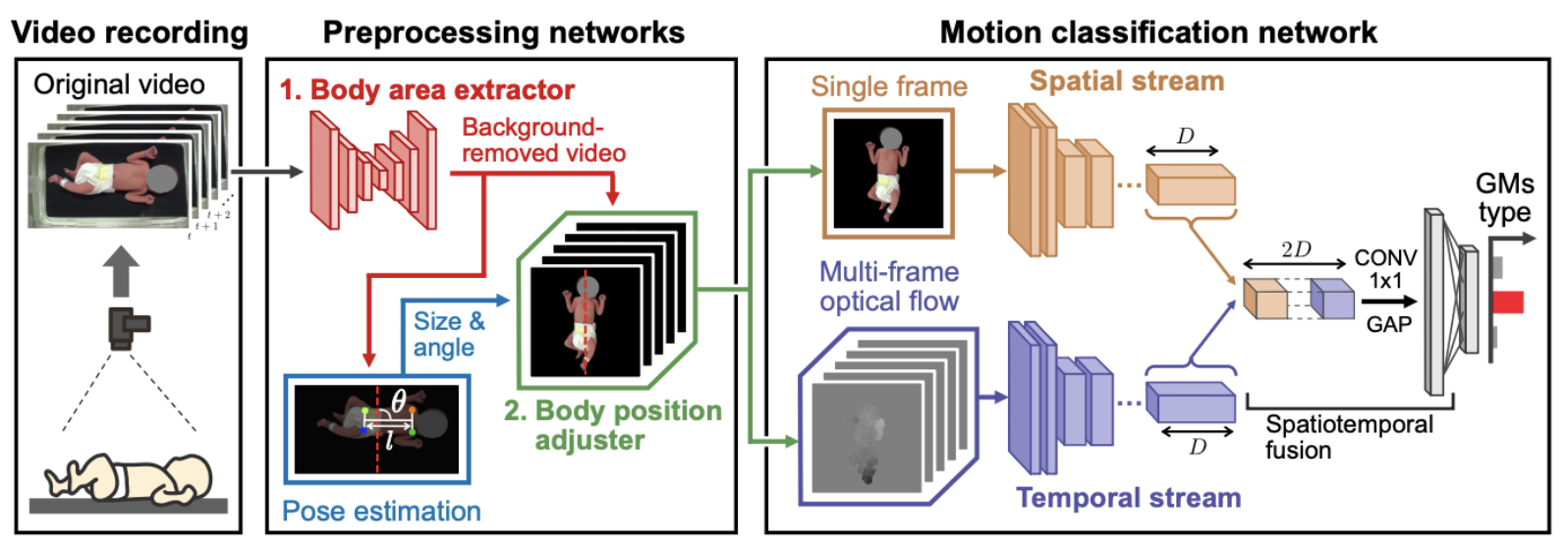
Objectively assessing neurodevelopment in infancy is important for identifying developmental characteristics such as autism spectrum disorder (ASD) at an early stage and providing opportunities for early intervention. However, the assessment of spontaneous movements (general movements) in neonates relies on observation by trained specialists, and objective, quantitative indicators are needed. In this research, we are developing methods that measure body movements markerlessly from videos captured with RGB cameras and quantify the spatiotemporal patterns of spontaneous movements. Using techniques such as non-negative tensor factorization, we decompose spontaneous movements into interpretable components and analyze how these features relate to later developmental measures using birth cohort data. By combining expert General Movements assessment with automatically extracted motion features, we aim to complement conventional observation-based assessment with quantitative measures and to capture developmental risk more reliably. Beyond movement, we also work on eye gaze measurement, analyzing characteristics of gaze patterns in infancy to capture autistic tendencies. We additionally participate in analyses of the association between prenatal chemical exposure and developmental risk. Technical approaches: - Markerless motion measurement using RGB cameras - Spatiotemporal decomposition of spontaneous movements via non-negative tensor factorization - Automation and quantification of General Movements assessment - Discrimination of autistic tendencies based on gaze characteristics

Keywords

InfantsMotion Analysis

Collaborators

  • Prefectural University of Hiroshima
  • Nagasaki University
  • Nagaoka University of Technology
  • Chiba University
  • Sorbonne Université / Hôpital Pitié-Salpêtrière (France)

Related Publicationsshowing 6 of 18

View All →
2026Journal

Manual and automated assessments of general movements in neonates are associated with early autism risk at 18 months

Annik Beaulieu, Catherine Saint-Georges, Isabelle Habgarth et al.

Scientific Reports

InfantsMotion Analysis+1
DOI
2025Int'l Conf.

Discriminative analysis of autistic tendencies at 18 months of age using eye gaze characteristics in 4-, 10-, and 18-month-old infants

Rena Ueda, Hirokazu Doi, Akira Furui et al.

Proceedings of 2025 IEEE/SICE International Symposium on System Integration (SII)

InfantsMedical Imaging+1
DOI
2025Int'l Conf.

Non-negative tensor factorization of infant spontaneous movements: a pilot study for ASD risk evaluation of newborn infants

Rikuya Yonei, Akira Furui, Hirokazu Doi et al.

Proceedings of 2025 IEEE/SICE International Symposium on System Integration (SII)

InfantsMedical Imaging+2
DOI
2024Journal

Risk of autism spectrum disorder at 18 months of age is associated with prenatal level of polychlorinated biphenyls exposure in a Japanese birth cohort

Hirokazu Doi, Akira Furui, Rena Ueda et al.

Scientific Reports

InfantsASD
DOI
2023Journal

Spatiotemporal patterns of spontaneous movement in neonates are significantly linked to risk of autism spectrum disorders at 18 months old

Hirokazu Doi, Akira Furui, Rena Ueda et al.

Scientific Reports

InfantsMotion Analysis+1
DOI
2022Journal

Prediction of autistic tendencies at 18 months of age via markerless video analysis of spontaneous body movements in 4-month-old infants

Hirokazu Doi, Naoya Iijima, Akira Furui et al.

Scientific Reports

InfantsMotion Analysis+1
DOI