
Research Projects
Robust EMG Pattern Recognition Against Individual Differences
Machine Learning / Deep Learning Recognition
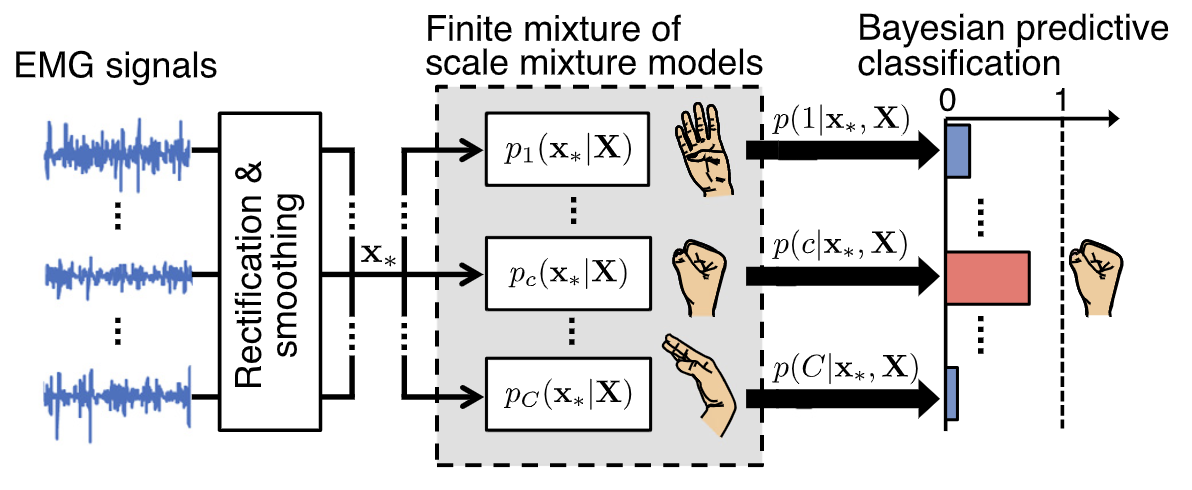
Research Overview
Motion classification algorithms that adapt to inter-subject and inter-trial variability
If we can decode human motion intentions from EMG signals, it can be applied to the control of various devices, including robotic prosthetic hands. However, the properties of EMG signals vary considerably with electrode placement, skin condition, and individual differences in muscle use. As a result, a classifier trained on data measured from one person on one day suffers a large drop in accuracy when applied directly to another person or another day. This vulnerability to inter-subject and inter-trial variability is the greatest barrier to the practical use of EMG interfaces.
Building on our findings on stochastic generative models of EMG signals, we address this problem within a deep learning framework. By disentangling subject-invariant features from motion-dependent features, we aim to generalize to new users, while also enabling rapid personal adaptation from a small amount of calibration data and continual learning that updates the classifier during ongoing use.
Technical approaches:
- Disentanglement of subject-invariant and motion-related features via adversarial learning
- Few-shot personal adaptation based on meta-learning
- Contrastive learning for representations robust to inter-trial variability
- Class-incremental learning combining generative and discriminative models
Keywords
EMGMotion RecognitionTransfer LearningMeta LearningContrastive LearningFeature DisentanglementAdversarial Learning
Quick Links
Related Publicationsshowing 6 of 24
View All →2026Int'l Conf.
Generative versus discriminative approaches for class-incremental learning of EMG signals: Effectiveness of scale mixture modeling
Seitaro Yoneda, Suguru Kanoga, Akira Furui
2026 IEEE International Conference on Systems, Man, and Cybernetics (SMC)
EMGMotion Recognition+3
2026Int'l Conf.
Contrastive learning for trial-robust EMG pattern recognition
Rina Tazaki, Akira Furui
2026 34th European Signal Processing Conference (EUSIPCO)
EMGDeep Learning+1
2026Int'l Conf.
Hybrid generative-discriminative learning of scale mixture models for EMG classification
Shunya Fukuda, Toshio Tsuji, Akira Furui
48th Annual International Conference of the IEEE Engineering in Medicine and Biology Society (EMBC)
EMGStochastic Model+2
2026Int'l Conf.
Subject-stratified meta-learning for few-shot adaptation in EMG-based gesture recognition
Ren Takeuchi, Akira Furui
48th Annual International Conference of the IEEE Engineering in Medicine and Biology Society (EMBC)
EMGMeta Learning+1