Research Projects

Stochastic Generative Models of EEG and Brain State Analysis

Biosignal Modeling and Analysis

Stochastic Generative Models of EEG and Brain State Analysis

Research Overview

Quantifying brain states through probabilistic models that capture EEG non-Gaussianity

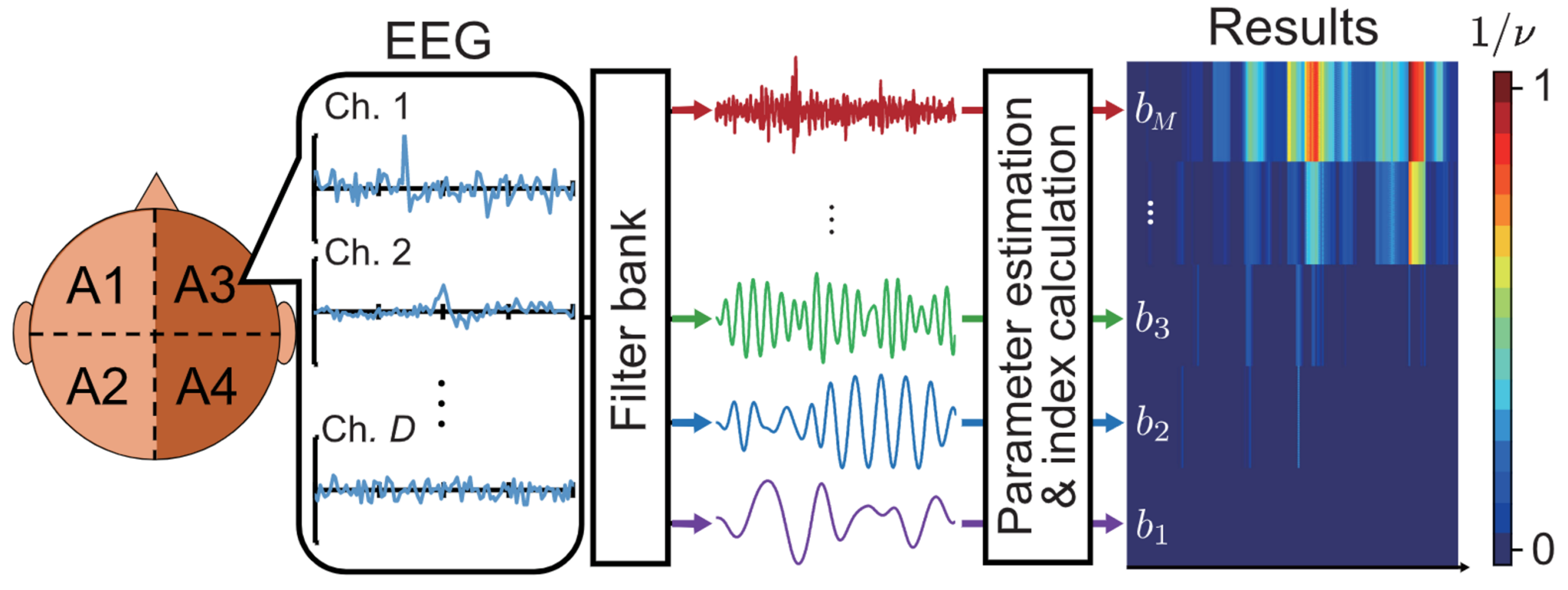
Electroencephalography (EEG) is the measurement of electrical activity generated by the brain from the scalp. It is known that characteristic waveform patterns appear in EEG depending on the brain state. For example, during sleep, characteristic waves such as spindles and K-complexes appear in EEG according to sleep depth. Additionally, when people with epilepsy have seizures, sharp waves such as spikes and sharp waves are observed. In this research, we are developing an approach based on stochastic generative models to accurately capture such EEG characteristics. Based on the modeling approach for EMG signals, and by considering the multidimensionality and time-series characteristics of EEG, we aim to capture the characteristic changes in EEG that change moment by moment according to brain states. By extending the model to represent not only the tail weight of the amplitude distribution but also its lateral asymmetry (skewness), features that appear in EEG according to sleep depth, such as slow waves and spindles, can be quantified as parameters of a probability distribution rather than detected directly from the waveform. The resulting features of stochastic fluctuation are applied not only to the evaluation of sleep states but also to the estimation of brain states more broadly, including the decoding of emotional valence. Main research features: - Quantification of EEG non-Gaussianity via probabilistic models that account for skewness - Analysis of stage-specific changes in sleep EEG characteristics - Application to decoding of emotional states

Keywords

EEGStochastic ModelSleep StageEmotionSpindle Detection

Related Publicationsshowing 6 of 12

View All →
2025Journal

Non-Gaussian modeling of sleep EEG based on a skewed scale mixture structure and its application to sleep stage analysis

Miyari Hatamoto, Akira Furui, Keiko Ogawa et al.

Biomedical Signal Processing and Control

EEGSleep Stage+1
DOI
2024Journal

Epileptic seizure detection using a recurrent neural network with temporal features derived from a scale mixture EEG model

Akira Furui, Ryota Onishi, Tomoyuki Akiyama et al.

IEEE Access

EEGSeizure Detection+1
PDFDOI
2024Int'l Conf.

Stochastic fluctuation in EEG evaluated via scale mixture model for decoding emotional valence

Shunya Fukuda, Akira Furui, Maro Machizawa et al.

Proceedings of 2024 IEEE/SICE International Symposium on System Integration (SII 2024)

EEGStochastic Model+1
PDFDOI
2022Int'l Conf.

Sleep EEG analysis based on a scale mixture model and spindle detection

Miyari Hatamoto, Akira Furui, Keiko Ogawa et al.

Proceedings of the 2022 IEEE/SICE International Symposium on System Integration (SII2022)

EEGStochastic Model+2
DOI
2022Domestic Conf.

生体電気信号の尺度混合確率モデルとパターン認識への応用

古居 彬

2022年電気学会電子・情報・システム部門大会

EMGEEG+1
2022Domestic Conf.

脳波の尺度混合モデルに基づく感情価の解読

福田 隼也, 古居 彬, 熊谷 遼 et al.

2022年電気学会電子・情報・システム部門大会

EEGStochastic Model+1